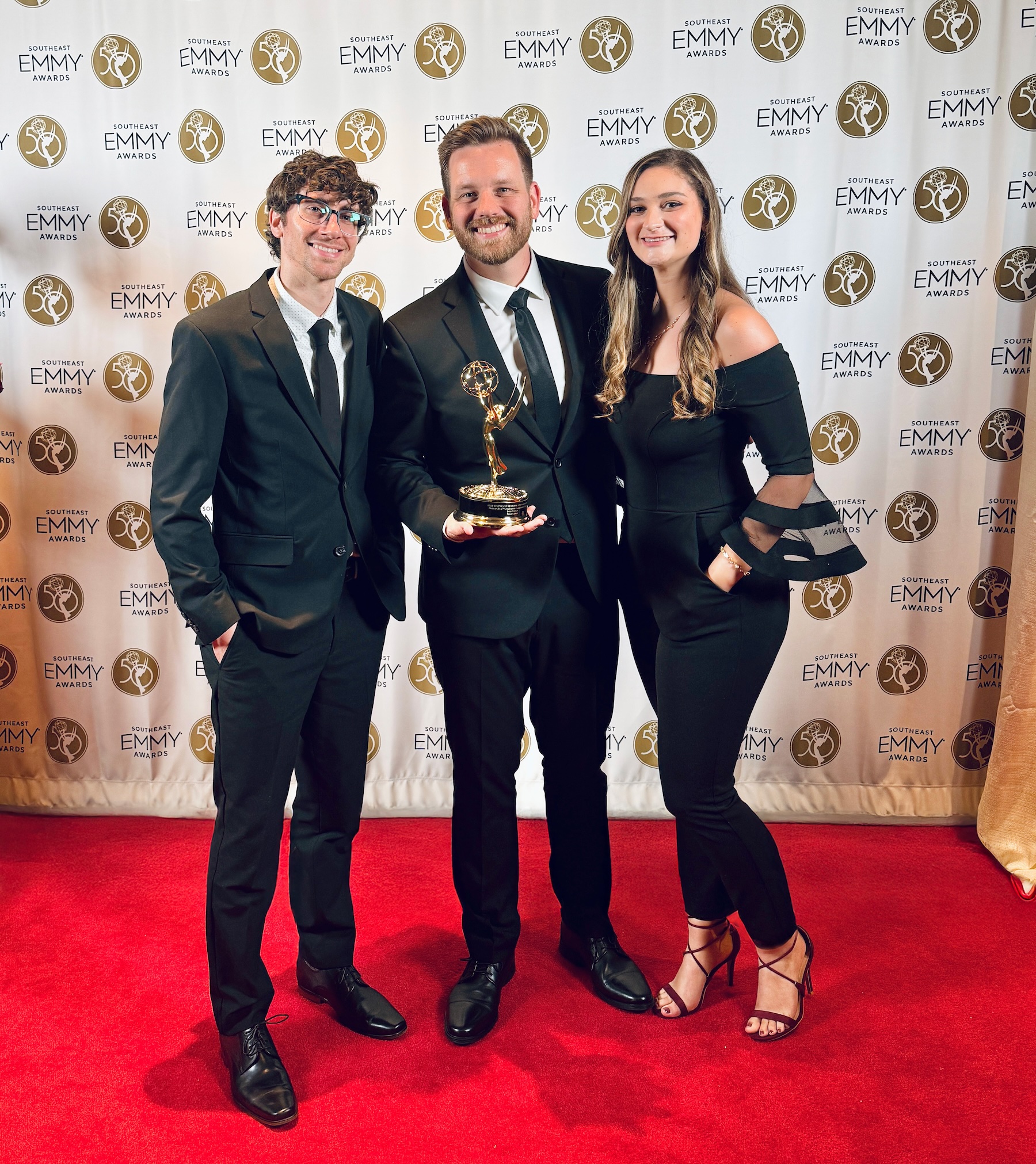
How did you find Anderson?
I went to a summer camp there and thought that the facilities were beautiful. I met some upperclassmen from Anderson who were running the camp and, as a high school senior, formed some great relationships with current students at Anderson. In my senior year of high school, I got to know the campus fairly well through current students and through some of the events that Anderson University put on. I fell in love with the campus and the culture there.
How did you become interested in communication?
My grandfather gave me a video camera when I was probably 10 years old. And from then on, I was shooting little films with my friends, and I documented my entire high school. I just always had a camera in my hands. I went to Anderson, and that passion continued of shooting and making films. I still had a video camera, and I was filming everything, but my major didn't line up with that.
I was halfway through my sophomore year. At the time Anderson didn't have the video production—I believe now it has a concentration in that. At the time it didn't, but communication was about the closest thing, and so I decided to go into the Communication major. At the time Dr. Duncan was leading that. I think there were only two video production classes, but he saw that a number of students were really interested in it and so he changed our senior seminar to video production. There I was able to shoot my first film. It meant a lot that he catered it to the interests of the students, and in a lot of ways, that really sparked in me that this is something I could make a career out of.
What are some favorite memories of college for you?
Anderson, at the time, was exactly the culture I needed. It felt like the whole campus was a tight knit community. I had my tight circle of friends, but there was a no one you saw on campus that you didn’t know. You knew their name, their major and their friend group. If you walked into the cafeteria, there wasn’t really a bad place to sit. You had your friends around, and I think there was just this really deep communal feeling there.
I have a lot of memories of leading worship at BCM, playing music in Daniel Recital Hall and Merritt Theatre, staying up late to practice music and then going to Waffle House afterwards. I have really amazing memories of doing all that.
What did you do after you graduated?
I graduated right at the tail end of the recession. Getting a job was very difficult. Through a lot of endurance and prayer, I landed a job at a company in Greenville. They're now called Confluence Outdoors, a massive manufacturer of kayaks and canoes. I became their first full-time social media manager, which was part of my job. It was social media management and video production. I did trade shows and events, a lot of marketing effort and ran the websites.
I think I was in one of the first classes where social media was even mentioned in 2009, 2010. When I came out, it was new in the sense of companies were saying, "We have to be on this platform, we have to engage this way.” I worked there for two years, did some video production during that time. Video was the thing I really loved, and so I decided, about two years in, that's really what I wanted to turn my efforts towards. It had been a passion of mine since I was a kid, and I decided to go for it. I left that job on great terms. They became my first client—I shot some product videos for them, and then just started pursuing video production. At the time, I was working in the Greenville, Anderson and Spartanburg areas.
I feel like it’s difficult for freelancers and contractors to be paid fairly and be paid on time and be treated well, and I really wanted to see that happen. And so I started my own company about two years in with that belief that people could be treated well, with respect and hopefully be treated better than they could anywhere else.

It's been a rewarding experience. We're in year nine and we've grown exponentially. We’ve shot all over the United States. We've worked for Coca-Cola and Lowe's and FIFA. We helped create a TV series that we filmed in Greenville. We shot internationally. Last year we were in Honduras. Last month, we flew out to Los Angeles.
I’ve had the opportunity to work with amazing crews, and I think a lot of that has to do with them knowing that when they work with Electric Soul they'll be treated very well.
Viewing your website, it looks like you work with a variety of clients—even some famous ones.
That's been one of the fun parts of my job. Every day is something new and every day is an opportunity to learn. I might be learning about medical device manufacturing one day, the next day I'm on a farm on tractors. We've done a couple of shows for Magnolia Network.
I always like to learn new things and that's another thing my grandfather and my mother both really instilled in me. My grandfather, from the time I was 10, probably around the same time he gave me the the video camera, would give me Popular Science and Popular Mechanics magazines that he subscribed to. I went to public high school, but I was homeschooled early in my life and my mom was really instilling in us a love for reading and a love for learning. I think things like that really served me well into adulthood.
Describe your team at Electric Soul.
Electric Soul is a small team. It's me and two other people, but we scale. I'm typically writer, director, producer, and then I have a few other people who work with me. One is also a director and an editor, and then another one's kind of a cinematographer, and he does some postproduction as well. But we expand as large as we need to per project.
Even though there are three of us on about every single shoot, there might be times when we've had crews of 25 to 30 people. The video production world is one of a lot of contract labor. We have probably a tight knit core and about 10 other crew members we can call on at any time, and then we can expand even larger than that if we need to.
How does Artificial Intelligence (AI) figure in your work?
I love talking about this. First of all, no technology is inherently evil or good. It's what you do with it. We get scared anytime there's a leap in technology, but if you do not embrace it in the right way, and if you don't create ways around using it, then you will be left behind. And so... AI for us... we use it to make our jobs easier. We don't use it to replace people.
What are some ways you feel your AU education helped you succeed in your work?
There are a lot of jobs now that you don't necessarily need a degree for, but the experiences that I got from college are irreplaceable, whether it was the education or whether it was just meeting my spouse, meeting people I do business with now, the community you form and the experiences you get are totally invaluable. I don't know of another place where you could live on campus and get to know people the way you can in the college experience. Having that experience with other students was just irreplaceable.
Dr. Duncan created this experience that equipped us to do a lot, to know a lot. Another thing that he equipped us to do was to take the initial thread of things like web design and social media that were rapidly evolving and learn the basics, but have a framework for how to learn more and how to adapt with the times. And so that I think was very important... also the community aspect of it all.
We have a co-work space who work tangental to me. They're all friends from college and we maintained not only friendships, but professional relationships. And so I think the open learning experience and the communal experience are things that have very deeply affected and benefited me in my professional career.
Where do you see intersections of your Christian faith and some of the work you do?
I am a Christian and many of people we work with are, but not all of them. And so we're not explicitly a Christian company, but I would say that my personal values and ethics, which are fully and heavily formed by being a believer, is so much of what the company is based on.
I talked earlier about just how we want to treat people with a lot of dignity and a lot of respect, and we want people to be treated better here or when they're on set with us, than they could be anywhere else. And that obviously flows out of my personal belief that people are made in the image of God, and every person has value. Our mission statement is to elevate and empower people through our work. We want the end product to be something that is elevating and empowering and inspiring to others. If someone comes to work with us, we want them to leave feeling elevated and inspired.
There have been jobs we've had to turn down... There have been times when I have asked crew members, would you be comfortable filming this? And if they say “no,” then we don't do it. At the end of the day, we want to make sure that when people look at us, what they see is a company that cares and a company that values people first and that has to do with how you treat people. That also has to do with the types of projects and what you put out in the world. And so we're we're always very conscious of that.
Where does most of your business come from?
We get a lot of word of mouth. Even working with Magnolia Network, begun by Chip and Joanna Gaines... The way we got that was a guy who works with us a lot was filming a TV show and the producer asked, “Are you available this date?” And he said, “I'm not, but you really need to call Micah at Electric Soul because if they're available, they'd be great for that.”
And then the other thing that happened during COVID... People were not traveling... A lot of companies might have typically flown in a crew or flown in a director, but no one was getting on planes. And so in 2020 and 2021, we got a lot of contacts from agencies in LA and Texas and New York who found us online, did a search of production companies in South Carolina, and they really liked us, I guess. And so a lot of them reached out and had us film for them in the Southeast. And that's how we made a lot of really great contacts.
We shot part of a documentary about Kevin Garnett for Showtime. They were looking for a crew here, and they found us and they were basically just like, “We like your work. We know you can do it. If you could do it in this budget, the job's yours.”
What advice would you give someone wanting to do video production professionally?
Anybody who wants to pursue this career—it can look so much different depending on what part you go into. Often it's 10 and 12 hour days on your feet. It's a good mixture of creative thought and manual labor. It's 50-50, and it can skew one way or the other depending on exactly what you're doing.
I think the best thing I could tell people is just find a film set, find a commercial set, and go watch and observe... Go on set and see the behind the scenes and see all the labor that goes into it, see if you really want to do it. And after watching that, if you decide you want to be part of that circus, go for it.
When you're not doing what you do professionally, what do you enjoy?
That’s a great question. We're nine years in, and I've definitely had to create healthy boundaries. I am married with three kids, and so creating healthy boundaries to have more spare time to be involved in my kids has been incredibly important and something I've really focused on in the last three years. So when I'm not working, which I really try to take a good amount of time off... I have three kids. They're nine years old and younger...
I love going to the movies. All my kids are pretty into art. So anytime we get the chance to, whether it's seeing a movie or whether it's going and seeing a musician or going to a concert. And then, we always are at an apple orchard at a pumpkin patch. Anything that's kind of outdoorsy that we can get out and do. I spend a lot of time with my wife and kids and we just kind of go on whatever adventure they take us on.
How did you meet your wife?
We met at Anderson. She was an education major. Her name is Jessica Taylor now, it was Jessica LaFail at the time. We met our freshman year and started dating senior years, so we were friends for a long time.