TRANSFER INTO SPRING SEMESTER.
Start your year with purpose. Classes begin in January.
Homecoming & Family Day
October 4, 2025

RESOURCE MENU

trojan watermark.jpg

RESOURCE MENU

trojan watermark.jpg
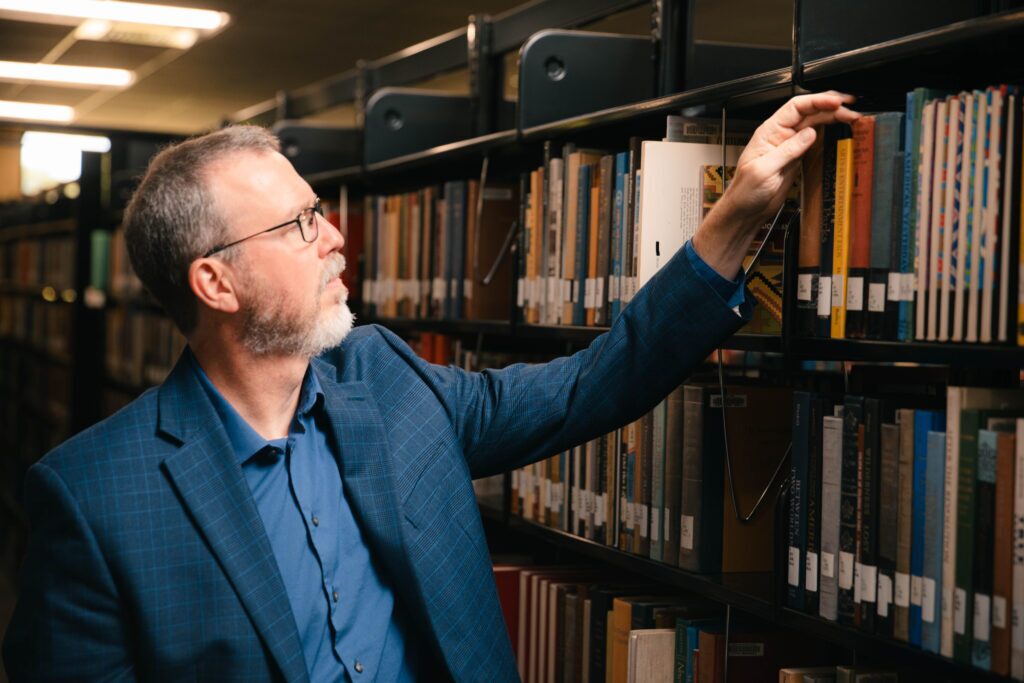
Nathan J. Cox in library
Fall 2025 Magazine

Artificial Intelligence

at Anderson University


Written by: Andrew J. Beckner

Can Great Academics survive—even thrive—amid the rise of such a transformative technology? For a group of Anderson University leaders charged with guiding its use at AU, the answer is clear.

Forget, for a moment if you can, the fears of AI. Forget the strange artwork it produces, the photos, the videos. Forget the erroneous information (or the eerily accurate information.) Forget that each time you use it, it seems to know a little more about you.

That’s not the point of the use of artificial intelligence at Anderson University. It serves a dual purpose: to further advance the foundational cause of Great Academics—and to bring glory to the God who created all.

Just ask Professor Nathan Cox.

Professor Cox, charged with spearheading a committee at Anderson University on the ethical use—and the higher education implications—of AI, is keeping his team’s focus where it belongs: on how students learn and, through that learning, how they make the world a better place.

“Generative artificial intelligence has the potential to transform the information economy, to reshape all levels of education, including higher ed, and perhaps even to alter the nature of teaching and learning itself. AI will likely influence all manner of institutional operations, but I’m primarily interested in how it impacts student learning,” Professor Cox said.

That commitment to possibility is driving a campus- wide strategy to integrate AI not only into academics, but also into the everyday operations of the institution. As AU positions itself as a leader among similar-sized institutions, administrators and faculty are working to make AI both a powerful tool and a responsible partner in the learning process.

Preparing Students for an AI-Driven World

Central to Anderson’s efforts is an understanding that AI is not merely a novelty—it is quickly becoming foundational to the future of work. Employers are already seeking graduates who are fluent in AI-assisted writing, content creation and data analysis. To meet this demand, AU sees it as a responsibility to equip students with the skills to use AI tools “creatively, productively and ethically.”

“We’re not just reacting to a trend,” Professor Cox said. “We’re preparing students for the world they’re about to enter—and the world they’ll be helping to shape.”

That preparation goes beyond simply learning how to use a chatbot. It involves critical thinking about the role of AI in society, reflection on its ethical implications and engagement with the very human questions of authorship, ownership and originality.

And it starts with a fundamental shift in how AI is perceived in the classroom.

From Policing to Partnership

As AI tools like ChatGPT and Midjourney entered mainstream consciousness, many educators raised concerns about academic integrity. Could students use AI to cheat? Would traditional assignments lose meaning? What does it mean to do your own work when machines can write essays or generate solutions in seconds?

At Anderson, those questions are not ignored—but they are reframed.

“Our mission isn’t to try to stop the inevitable advance of technology,” Professor Cox said. “It’s to partner with students in learning how to use it well.”

Rather than relying on flawed AI detectors or punitive systems, AU is focusing on pedagogy that emphasizes process over product. Faculty are exploring new ways to design assignments that encourage iteration, feedback and reflection, approaches that benefit learning with or without AI tools.

“Students need to be able to articulate what they’ve learned, to reflect on their process and to evaluate the quality and accuracy of AI-generated content. That’s not just a workaround. That’s good teaching,” Professor Cox said.

As a Christian university, AU also draws on its values to guide conversations around honesty, creativity and intellectual integrity.

“That framework helps us,” Professor Cox said. “It gives us a shared language for talking about the value of our work and our responsibilities to one another.”

Professor Cox in Anderson University's library looking at a shelf full of books
AI as Opportunity

While much of the public debate around AI centers on its risks, Anderson is also highlighting its opportunities.

Across the university, AI is being used to support marketing, streamline communication, analyze data and even aid in recruitment. But perhaps the most exciting opportunities are in the hands of students.

From generating study guides to editing essays, visualizing concepts, writing and debugging code, or translating content into another language, students are finding ways to use AI as a tutor, editor and creative partner.

Instructors, too, are experimenting.

“We can use this technology to make ourselves and our world better, but only if we treat it as a tool, and not a replacement for the gifts God has given us,” said Dr. Katherine Wyma, associate professor of English in the Anderson University College of Arts and Sciences. Dr. Wyma was among those charged with developing a framework for the ethical use of AI at AU.

And that last point is key: regardless of the advance of technology, God remains the foundation of the University—and of the world.

“It’s the same challenges that are posed for society as a whole: what makes us human? How can we flourish where God has called us to be even with the challenges that AI offers? How can we see God’s provision for learning, work and play as integral to our humanity instead of seeking to replace those things with AI?,” she said.

“We may be surprised by the arrival of AI, but God is not,” she said. “This is another opportunity for Christian scholars to answer perennial questions with foundational answers: how can we apply unchanging truth to a changing world?”

What’s Next for AI at AU?

This is the million-dollar question. For Professor Cox, he is optimistic.

“We’ll continue emphasizing that there are times when students will need to use AI, and times when they will need to be able to work completely independently of it. The ethics of the AI industry and of any personal use of will need to be central to our conversations. Like any technology, AI can be used for positive and negative purposes. But staying focused on the learning and student success is critical,” he said.

“After all, that’s AU’s whole reason for being. If our students are successful, AU is successful. But so far, we have a pretty good track record of success. The growth and progress I’ve seen in my 23 years at AU has been unique and special. I expect AI, with all its challenges and the rapid pace of change, will help us and our students go even farther.”

Advisory Committee Members
AI @ AU

Professor Nathan Cox

Dr. Paige Ellisor-Catoe

Dr. Joni McCullar Criswell

Dr. Melanie Croft

Dr. Robert G. Franklin, Jr.

Dr. Martin Jones

Dr. Evie Maxey

Professor Jer Nelson

Professor Charity Yost Reed

Professor Bobby Rettew

Dr. S. Andrew Stowe

Chad Treado

Dr. Kimberly Whitehead

Dr. Katie Wolfe-Burleson

Dr. Katherine Cooper Wyma

Professor Nathan Cox

Dr. Paige Ellisor-Catoe

Dr. Joni McCullar Criswell

Dr. Melanie Croft

Dr. Robert G. Franklin, Jr. 

Dr. Martin Jones

Dr. Evie Maxey

Professor Jer Nelson

Professor Charity Yost Reed

Professor Bobby Rettew

Dr. S. Andrew Stowe

Chad Treado

Dr. Kimberly Whitehead

Dr. Katie Wolfe-Burleson

Dr. Katherine Cooper Wyma

Artificial Intelligence at Anderson University
Resources and Information

Artificial Intelligence at AU Vision Statement

Artificial Intelligence at AU Resources and Tutorials through the Thrift library

MORE FROM THIS EDITION