

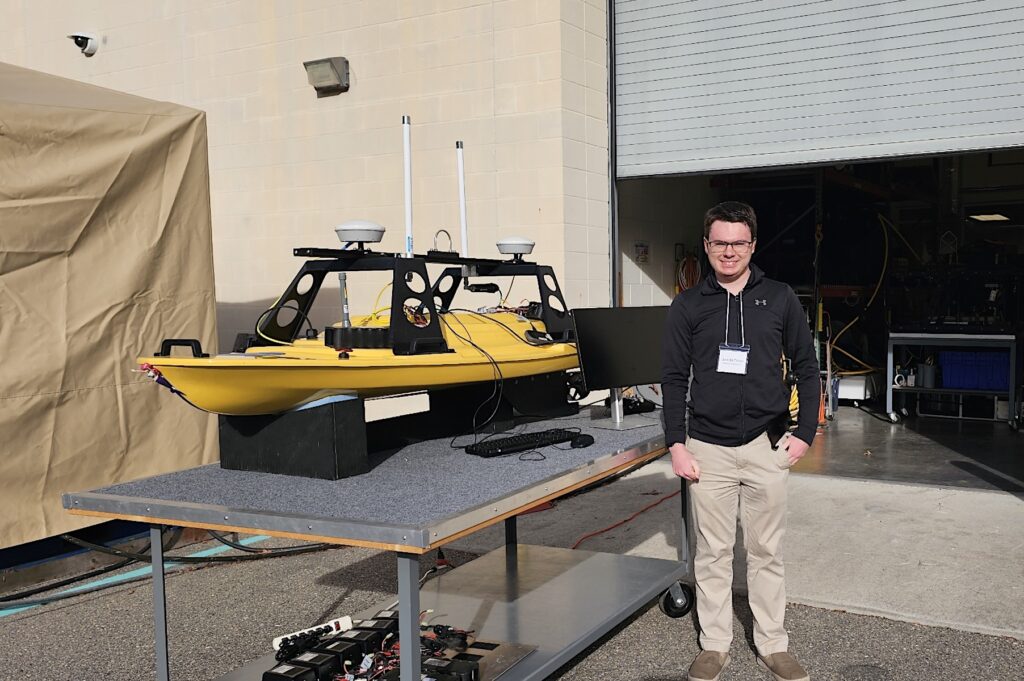
Anderson University Cybersecurity major John “Jack” McCotter took part in a competition devoted to technologies that guide global maritime transportation.
McCotter, along with students from across the nation, was invited to compete in the University of North Carolina Wilmington Cybersecurity Marine Hackathon, a fast-paced, hands-on academic event hosted by the UNCW Center for Cyber Defense Education December 16-18, 2025.
The competition exposed students to technologies needed to safely guide ships over thousands of miles and also monitor their many internal onboard systems. Its objective is to strengthen the maritime cybersecurity workforce through applied learning, simulation-based challenges and collaboration across academia, industry and government.
Technologies studied ranged from Modbus, a protocol that is used to monitor and control systems on board—to Global Positioning Systems (GPS) used aboard ships.
“Everything is computer-based now,” McCotter says, adding that the huge printed nautical charts that guided generations of ship captains have become obsolete. “The government stopped making paper charts… If your data gets breached, that’s a big problem… If systems go down, that’s a big problem, too. If port operations go down, that’s a huge problem. If a boat can’t see the depth of the water, if radar stops working because someone is jamming it somehow, that’s a huge problem.”
A big takeaway for McCotter and others involved in the competition is the need for qualified professionals to assess ships, new and old, for technical vulnerabilities, finding effective and feasible ways to secure systems that these vessels rely on for safety while underway and to get safely from port to port.
“One of my favorite workshop challenges involved a USV (Uncrewed Surface Vehicle),” said McCotter. “This boat had a computer as the controller. We were able to use real-world scanning tools such as Nessus to see what vulnerable services and operating systems were on the vehicle.”
A final challenge for McCotter and members of his team was a deep dive into NMEA 0183, a protocol used to connect onboard components.
McCotter explains that encryption is an important and much-needed part of future protocols needed for security in the maritime industry.
“A lot of what we learned in cryptography… We’ve been able to figure out how future and current encryption technologies work,” he said.
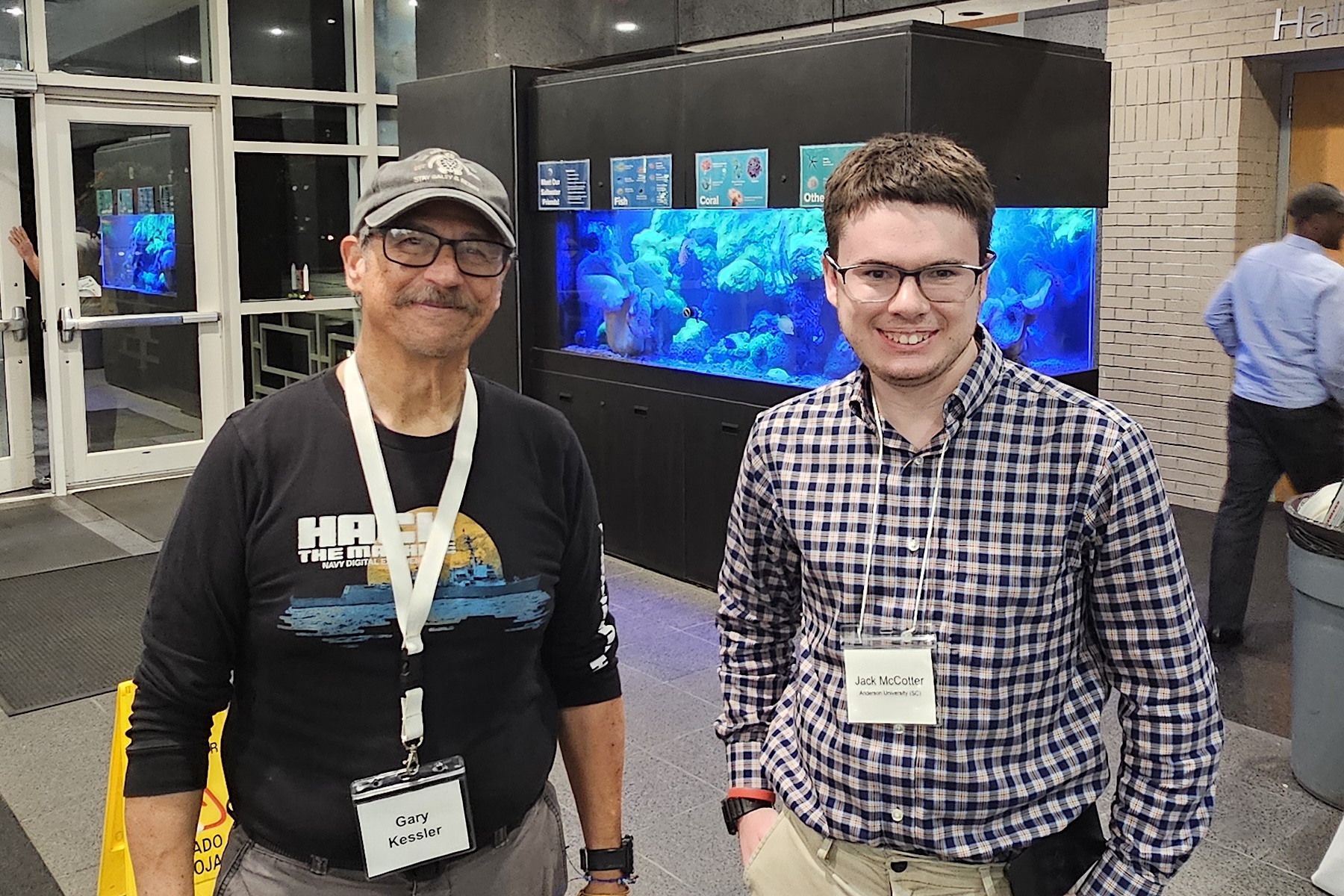
McCotter enjoyed getting to meet and work with students ranging from freshmen to those in doctoral programs. A highlight was working with marine cybersecurity expert Gary Kessler, pictured above at left, as he provided insights into maritime industry technology. With Kessler’s guidance, they learned how to sniff network traffic and execute a replay attack against an MFD (Multifunctional Display).
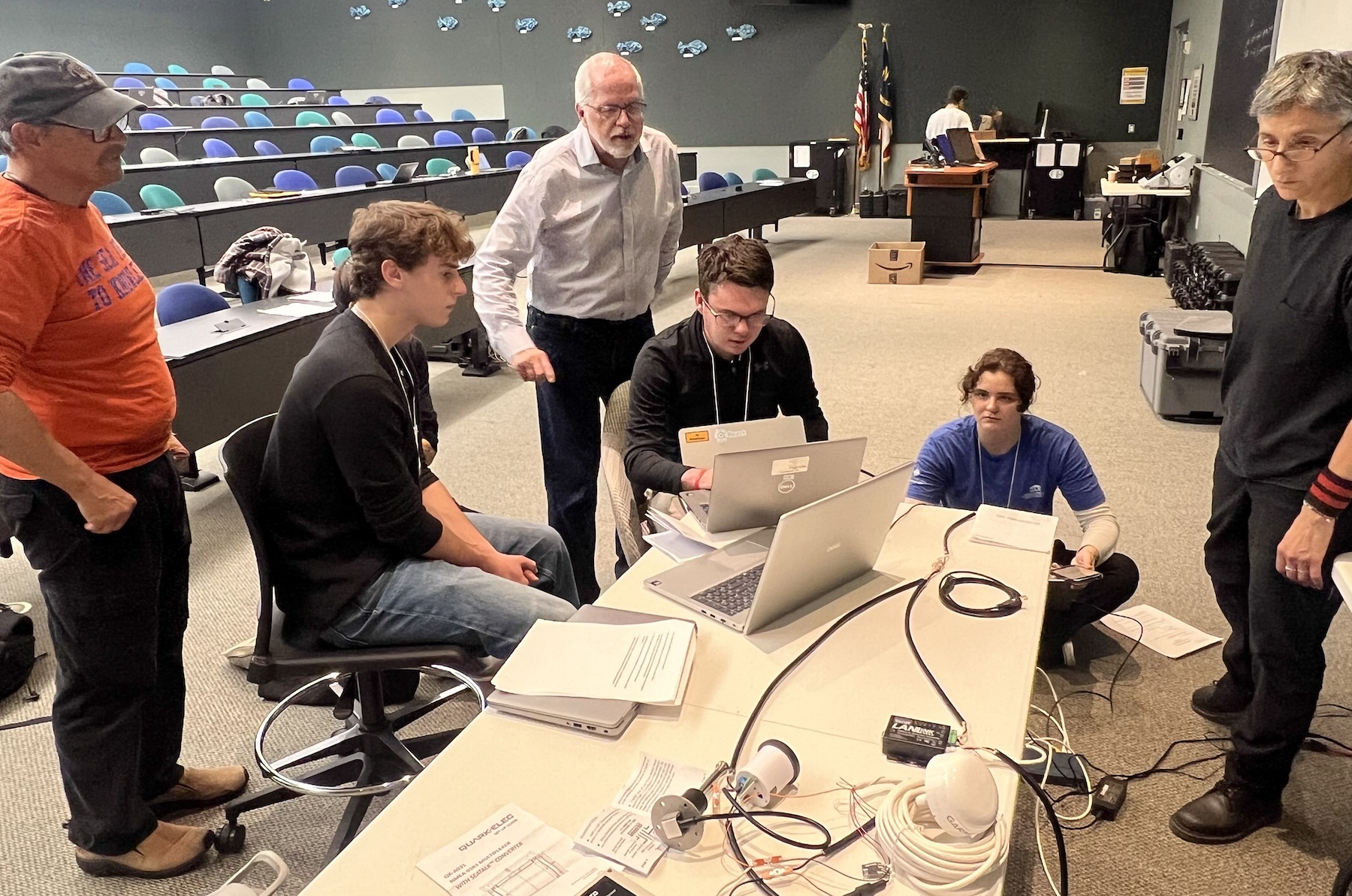
“It was a great experience to see what packets a real GPS sensor sent and then create our own packets to send to the display. In the end, we were able to make a moving ship that was moving across the display at whatever speed we specified,” said McCotter, pictured above typing into a laptop. “In the end I learned a lot about large vulnerabilities that are still used in a large majority of marine systems today.”
“This is one of the incredible examples of our students taking everything they learn and experience within our classes and competitions and applying it in the real world to make our world safer and more secure,” said AU Cybersecurity Professor Brandon Grech.
“I’m hoping to get involved in a little bit more marine cybersecurity research—more specifically, study the specific protocols that boats use to communicate,” said, McCotter, who is thinking about getting a master’s degree in cybersecurity engineering.