


Since Dr. Lindsay Privette’s book The Surgeon’s Battle: How Medicine Won the Vicksburg Campaign and Changed the Civil War was released this past September, it has been gaining attention in history circles. New Books Network interviewed Dr. Privette about her book April 4.
Dr. Privette is a professor in the Department of History and Political Science of the Anderson University College of Arts and Sciences. Her book takes a unique look at the Civil War through the lens of healthcare. Rather than focusing on Washington and battles in the east, Dr. Privette’s book pulls things farther west.
Dr. Privette’s fascination for the Civil War came at an early age when she grew up in Vicksburg, Mississippi, site of the historic Siege of Vicksburg, a crucial campaign. She recalls many family trips to the historic battlefield and even worked briefly as a ranger at the Vicksburg National Military Park.
At Vicksburg, in addition to battle-sustained injuries, there were illnesses related to Union soldiers being in an environment they weren’t accustomed to, as they dealt with southern heat and humidity as well as mosquito-borne illnesses like malaria. Despite it all, Union forces prevailed over the Confederate Army in the end.
In Dr. Privette’s book is an exploration of the interrelationship and tensions that often arose between medical professionals and Union Army leadership. Lessons learned early in the war and their impact on the effectiveness of rendering medical aid in the field and at military hospitals are examined in the book.
“I think medicine in the Civil War is something that really intrigues people when they stop to think about it, and one of the things I’m noticing is that a lot of people haven’t stopped to think about it quite yet,” Dr. Privette said. “What my book is really doing is creating some of these conversations.”
While Dr. Privette points out that the germ theory hadn’t yet been established, medical officials were starting collect information to help practitioners understand how different surgical techniques affect their patients and codify prognoses to make more informed decisions at the operating table. William Hammond, a career medical officer who became surgeon general during the war years, helped spur on improvements in the medical care of soldiers.
“This particular book intersects at a lot of different places that people would find interesting,” she said. “Even though I talk to other scholars, it’s written for a general person who just enjoys Civil War history or enjoys reading history.”
Dr. Privette adds, “One of the things I think so interesting about studying Civil War history is that no matter how bleak some current day things may be, we’ve seen some pretty dark times in our nation’s history in the past and we’ve recovered and were unified on the back end of that.”
The Surgeon’s Battle: How Medicine Won the Vicksburg Campaign and Changed the Civil War has been reviewed by Library Journal (American Library Association) and other reviewers specializing in Civil War history.
“Based on a wide range of military correspondence, surgeons’ reports, and other records, this concise book will fascinate and educate readers interested in the U.S. Civil War and medical history,” said an online review in the Library Journal.
A review in Emerging Civil War (emergingcivilwar.com) concludes, “Privette offers readers interested in Civil War medicine and Vicksburg a valuable work that medical adaptability was central to Union success in compelling the Confederates to surrender on that Independence Day morning.”
Civil War Books and Authors, an independent, non-fiction American Civil War book review journal, calls Dr. Privette’s book “a noteworthy addition” to the history of Civil War medicine.
“Keeping in mind the environmental extremes within which the Vicksburg Campaign was fought as well as period limitations in the scientific knowledge of disease processes and transmission,” the review states, “Privette’s study nevertheless successfully argues that Grant’s Army of the Tennessee incorporated improvements in medical department organization and practices that were numerous and significant enough to mitigate the effects those unavoidable factors had on soldier health and fighting efficiency.”
Dr. Privette hopes in the future to look further at medical providers in terms of how they emotionally dealt with things they saw and did during the war; also how those experiencesimpacted them, both professionally and personally as they transitioned into their postwar lives.
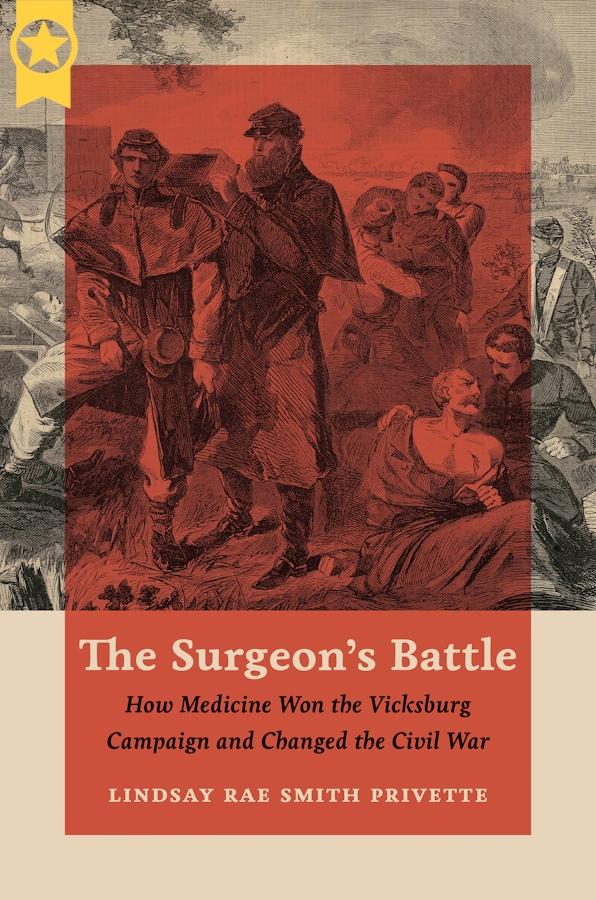
The Surgeon’s Battle: How Medicine Won the Vicksburg Campaign and Changed the Civil War is published by UNC Press and can be found online at Amazon, Barnes and Nobleand other major retailers in printed and eBook versions. It’s also available at many retail bookstores.