Apply for Spring 2027 now! Classes begin in January

RESOURCE MENU

trojan watermark.jpg

RESOURCE MENU

trojan watermark.jpg
The conservatory of music
Winter 2026 Magazine

The Conservatory

of music

Serious Musical Training, Broadly Educated Musicians

Anderson University is building a conservatory for serious musicians—and doing so within the intellectual breadth of a comprehensive Christian university.

The establishment of The Conservatory of Music gives a new institutional identity to a music program that has developed considerable depth in performance, professional preparation and musical scholarship. More importantly, it establishes a clear direction for the program’s future.

Anderson intends to build a conservatory in the fullest tradition of the word: a place where talented musicians receive intensive, disciplined training from accomplished artist-teachers and where performance, artistry and professional preparation receive sustained institutional attention.

At the same time, the Conservatory will remain firmly grounded in something essential to the University’s character. Its musicians will be broadly educated students of a comprehensive Christian university, encountering literature, religion, philosophy, history, science and other fields alongside serious musical study.

That combination is not incidental to the Conservatory. It is central to its purpose.

The Anderson University Board of Trust approved the change at its February meeting. President Evans Whitaker announced the new designation during the University’s annual President’s Gala, which featured performances by students and faculty from across the University’s performing arts programs.

The Conservatory remains part of The South Carolina School of the Arts, which brings together music, theatre, dance and art and design.

Dr. David L. Perry, formerly chair of the Department of Music, now serves as director of the Conservatory of Music. He leads the Conservatory’s academic programs, ensembles, faculty, students and artistic development.

Developing a Conservatory

A conservatory exists to take music seriously and train serious musicians.

Its students devote substantial time and attention to their discipline. They study privately with accomplished musicians,  perform frequently, receive direct and demanding artistic evaluation, and develop the technical and interpretive skills required for professional work.

Anderson already provides that foundation.

Its music programs offer professional Bachelor of Music degrees and sustained one-on-one study with artist-teachers who remain active as performers, composers, conductors, scholars and clinicians. Students participate in juries, recitals and ensembles while developing their musicianship through intensive study and performance.

The Conservatory designation gives these elements a clearer institutional identity and establishes a framework for strengthening them.

The University intends to raise performance expectations, strengthen audition and recruitment processes, attract increasingly accomplished students and faculty, expand opportunities for public performance, and continue developing the facilities and resources necessary for serious musical study.

Dr. David Larson, former dean of The South Carolina School of the Arts, helped envision the development of the Conservatory.

“For years, Anderson’s music programs have demonstrated the depth, discipline and artistic excellence associated with conservatory training,” Larson said. “The Conservatory framework gives us the opportunity to build on that foundation with even greater focus on performance, faculty excellence and professional preparation.”

The ambition is straightforward: Anderson intends to develop a conservatory capable of standing alongside respected programs nationally while remaining unmistakably part of Anderson University.

Music and the Liberal Arts

The Conservatory’s place within a comprehensive university is one of its defining strengths.

The liberal arts remain the foundation of an Anderson education. That foundation shapes the intellectual life of the University and the education of every student. At the same time, Anderson today is a comprehensive university, offering a broad range of undergraduate and graduate programs across the arts and sciences, business, education, health professions, engineering, ministry and other professional fields that produce exceptional workforce-ready graduates.

Those identities are not competing ones. A comprehensive university brings disciplines into relationship with one another and provides students with multiple paths toward professional preparation while retaining the intellectual breadth of a university.

Approximately 80 percent of Anderson undergraduates pursue majors designed for professional preparation. That reality does not diminish the University’s liberal arts foundation. It demonstrates how Anderson applies that foundation to the education of students preparing for professions and vocations.

The Conservatory belongs naturally within that model.

A musician’s education should extend beyond musicianship. Great music does not exist in isolation from history, ideas, language, culture, theology or the human experience. A serious musical education therefore benefits from serious engagement with the world beyond the practice room and concert stage.

At Anderson, conservatory training will remain connected to the University’s liberal arts foundation and Christian intellectual tradition.

Students can pursue demanding professional musical study without giving up the breadth of education that comes from studying in a comprehensive university. They can become better musicians while also developing the intellectual habits necessary to understand the cultural, historical and human dimensions of the art they practice

That integration also reflects Anderson’s Christian mission.

The Western musical tradition developed within a civilization profoundly shaped by Christianity. Yet contemporary professional arts education can sometimes treat the intellectual and spiritual traditions that formed that inheritance as peripheral to artistic training.

Anderson intends something different.

The Conservatory will pursue technical mastery and artistic excellence while engaging seriously with the Christian faith and the intellectual and artistic traditions that have shaped Western culture. Its students will not have to choose between rigorous musical preparation and a substantive education in the liberal arts.

They will receive both.

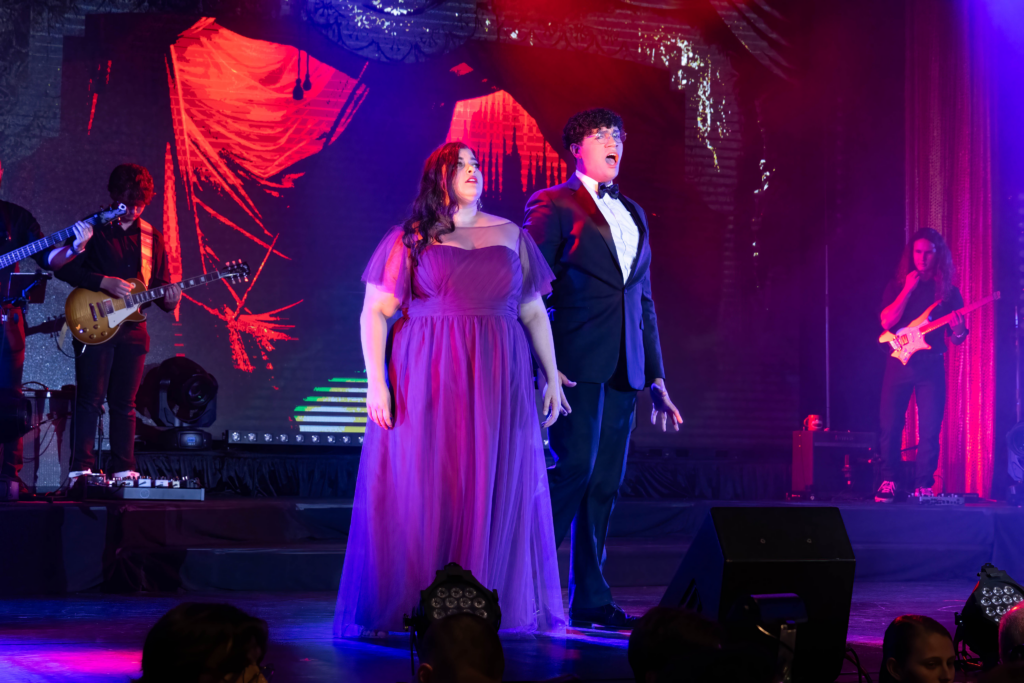
Student singing on stage

Spring 2025 Commercial Music Concert

The Johnny Mann Center for
Commercial Music

The Conservatory also encompasses the Johnny Mann Center for Commercial Music, honoring the late Johnny Mann, the Grammy-winning arranger, composer and longtime musical collaborator of Lawrence Welk.

Mann’s career encompassed television, recording, arranging and choral music. His work demonstrated the range of professional possibilities available to musicians whose training allows them to move confidently among performance, composition, arranging and production.

Mann was also a friend and supporter of Anderson University and of President Evans P. Whitaker and his wife, Diane. Following his death, his wife, Betty, arranged for his compositions and significant papers to be transferred from Pepperdine University to Anderson, where they will remain in perpetuity.

The Center gives Anderson’s commercial music students a specialized environment in which to study the contemporary music profession. Students work across genres and disciplines, including popular music, rock, jazz, songwriting, studio production, worship leadership and music for media.

Their preparation encompasses performance, songwriting, recording, production and the business of music.

Audio 316 Records

A distinctive feature of Anderson’s Conservatory of Music is Audio 316 Records, a student-operated record label that gives students the opportunity to experience the music industry from the inside. Rather than simply studying recording, production, marketing, and music business, students work together to develop artists and original music and bring that music to the public.

Audio 316 provides hands-on experience in songwriting and recording, music production and engineering, artist development, branding, social media and visual content, music distribution, release campaigns, and the entrepreneurial side of the industry. This work is supported by Anderson’s professional recording facilities, where students have access to dedicated recording and production spaces and learn to work with the equipment, software, and production techniques used in today’s music industry. The label also brings together students from across the South Carolina School of the Arts, including Commercial Music, Worship Leadership, and Musical Theater, creating a genuinely interdisciplinary professional experience.

Together, Audio 316 and Anderson’s recording studios give students something more than classroom instruction: the opportunity to create, record, produce, release, and promote music in a professional environment while building the practical skills and portfolio experience needed for careers in the contemporary music industry.

To sample some of Audio 316’s latest releases, go to: https://andersonuniversity.edu//audio316music/

A Conservatory Within a Distinguished Arts School

 The Conservatory is part of a School of the Arts with professional accreditation across music, theatre, and art and design.
 

Anderson holds specialized accreditation from the National Association of Schools of Music (NASM), the National Association of Schools of Art and Design (NASAD), and the National Association of Schools of Theatre (NAST).

Only four Christian universities in the United States hold accreditation across all three of those specialized arts disciplines

Those accreditations provide independent external standards for curriculum, faculty qualifications, facilities and educational practice. They also reflect the University’s commitment to professional arts programs that meet the expectations of their respective disciplines

Investing in the Future

The Conservatory’s development will require sustained investment.

Anderson plans to strengthen practice and rehearsal spaces, expand scholarship support, develop endowed professorships and continue investing in the faculty and programs necessary to attract exceptional students.

Some of those priorities will become part of the University’s planned $120 million comprehensive fundraising campaign.

These investments serve a larger purpose. A conservatory depends upon people, not simply facilities: accomplished faculty, talented students, serious instruction and an environment that expects students to develop their abilities to a high level. Anderson intends to build all those elements.

“With more than 20 ensembles representing instrumental, choral, jazz, commercial and worship traditions, our students already have substantial opportunities to perform and collaborate,” Perry said. “The Conservatory gives us the opportunity to deepen that experience and to establish even higher expectations for our students.”

For President Whitaker, the Conservatory represents an extension of Anderson’s longstanding approach to education.

“We want our students to become exceptionally capable musicians, but we also want them to become educated human beings,” Whitaker said. “The two should not be separated. A conservatory can demand the highest standards of musical excellence while remaining grounded in the intellectual breadth, Christian faith and liberal arts tradition of the university in which it exists. This is one way a Christian university remains distinctively Christian while competitors increasingly focus on a transfer of information rather than the formation of whole persons.”

Anderson faculty and students have repeatedly demonstrated their ability to advance from one level to the next. The Conservatory gives them a new framework in which to pursue that work with even greater focus and ambition.

The University will continue to invest in the people, spaces and resources that serious musical education requires. It will recruit talented musicians, develop accomplished artistteachers, strengthen performance opportunities and deepen the intellectual foundations that give the Conservatory its distinctive place within Anderson.

The Conservatory will demand serious musical study. It will expect artistic discipline. It will prepare students for professional lives in music.

And it will do all of that within the larger work of educating men and women to understand their art, their culture, their faith and their world.

The name is new. The ambition and trajectory are larger.
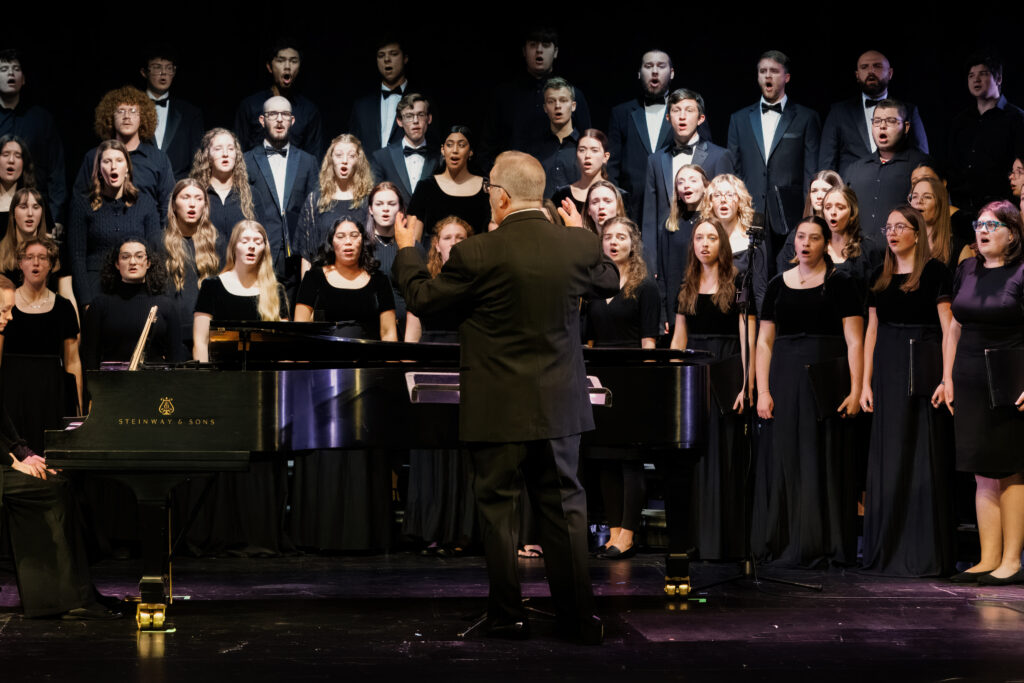
Concert Choir Singing on Stage

Help Build the Conservatory

The Conservatory will require permanent resources if it is to sustain excellence across generations.

Alumni and Friends of Anderson University can help establish that foundation through the Office of Development, with opportunities to create:

• named, competitive endowed scholarships that will attract exceptional musicians;
• establish funds to perpetually replenish pianos and other instruments as they age and require replacement;
• and create endowed professorships that will help Anderson recruit and retain outstanding artist-teachers.

These gifts can provide lasting support for the students, faculty and instruments on which the Conservatory depends. An endowed scholarship can open the door for a gifted musician. An endowed professorship can secure the presence of an accomplished artist-teacher. An instrument endowment can ensure that students have access to the equipment their training requires for generations to come.

To learn more about supporting the Conservatory, contact the Anderson University Office of Development at (864) 231-2147.