

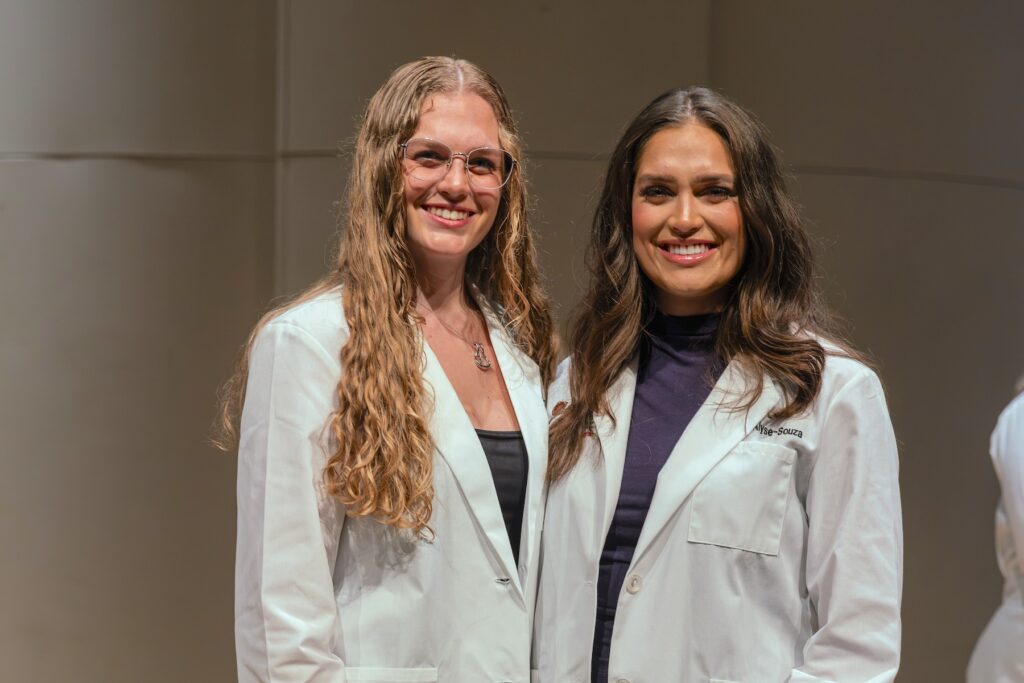
Two Anderson University Pathologists’ Assistant students took their research from the classroom to a national audience, presenting their work at the American Association of Pathologists’ Assistants (AAPA) Annual Conference in Phoenix, Arizona.
Graduate students Kayla Thomas and Delaney Alyse-Souza received AAPA Student Delegate Scholarships, supporting their attendance and providing the opportunity to present research projects developed during the didactic portion of Anderson University’s Pathologists’ Assistant program. The pair also became the first Anderson University students to attend the conference as AAPA student delegates.
For Thomas, the opportunity provided a national platform to explore a rapidly developing area of pathology: artificial intelligence. Her project, “Artificial Intelligence Integration into the Pathologists’ Assistant Workflow,” examined the ability of general-purpose artificial intelligence programs, including ChatGPT and Gemini, to generate grossing templates based on College of American Pathologists protocols.
Building on that research, Thomas developed PathAssistAI, an AI-based educational tool designed to generate more standardized grossing templates, cassette summaries and inking protocols while providing feedback that could help PA students practice specimen dictation.
Her research also revealed important limitations of current AI tools.
“One thing I didn’t fully appreciate at the beginning was how inconsistent general-purpose AI could be,” Thomas said. “That really showed me that general AI isn’t enough, especially in a field like pathology where consistency and accuracy are extremely important.”
Presenting the project allowed her to discuss both the possibilities and limitations of AI with practicing Pathologists’ Assistants, including professionals who were skeptical of its use.
“I really enjoyed discussing whether AI could realistically be incorporated into the grossing workflow and what safeguards would need to be in place for it to be used responsibly,” she said.
Alyse-Souza’s project drew from her professional experience before entering Anderson’s program. Prior to graduate school, she worked as a tissue recovery technician with Mid-America Transplant in St. Louis, Missouri. Her research proposed expanding the role of Pathologists’ Assistants into tissue and organ donation, where their knowledge of anatomy and pathology could potentially contribute to donor evaluation, protocols and efforts to reduce preventable tissue and organ discard.
“Before attending AU’s program, my career as a tissue recovery technician with Mid-America Transplant profoundly affected my life,” Alyse-Souza said. “I noticed while working that having a pathology professional involved could help lower the discard rate of organs and tissues due to anatomical or pathological reasons.”
During her research, Delaney also identified limitations in the availability and timeliness of national discard data, leading her to consider another potential role for Pathologists’ Assistants: helping develop standardized protocols and procedures that could strengthen data collection and reporting.
For Alyse-Souza, one of the most meaningful responses came from conference attendees who told her they had not realized the problem existed.
“Tissue and organ donation is something that many don’t think about until a loved one passes away,” she said. “Advocating for this area and spreading the word was important to me, and I think I accomplished that.”
Beyond their individual presentations, both students described the conference as an opportunity to learn from practicing professionals, connect with other PA students and become more engaged with the profession they will soon enter.
For Thomas, presenting also provided an opportunity to represent the program that prepared her for the experience.
“The professors of the PA program at Anderson University care so much about mine and other students’ education and success, so being able to represent the program at the AAPA conference was something I took a lot of pride in,” she said.
Alyse-Souza shared that sense of pride in representing Anderson on a national stage.
“Kayla and I were the first-ever student delegates from AU, and it was incredible to have that honor,” she said. “I believe we proved that the AU Pathologists’ Assistant program is producing top-quality graduates that will enter the workforce with passion and dedication.”
Both students returned from Phoenix with an expanded professional network and renewed enthusiasm for their clinical training and future careers.
“The conference made me even more excited for what the rest of my clinical year will bring,” Thomas said. “I hope to become a PA who is always willing to learn, ask questions, and look for ways to improve the field, while always keeping patient care at the center of what I do.”
For Alyse-Souza, the experience reinforced that she had found both the right career and a profession in which she hopes to remain actively involved.
“I left the conference feeling absolutely invigorated to have found this profession and eager to get start,” she said. “I can’t wait to get involved after graduation and bring more attention to how life-saving pathology is.”
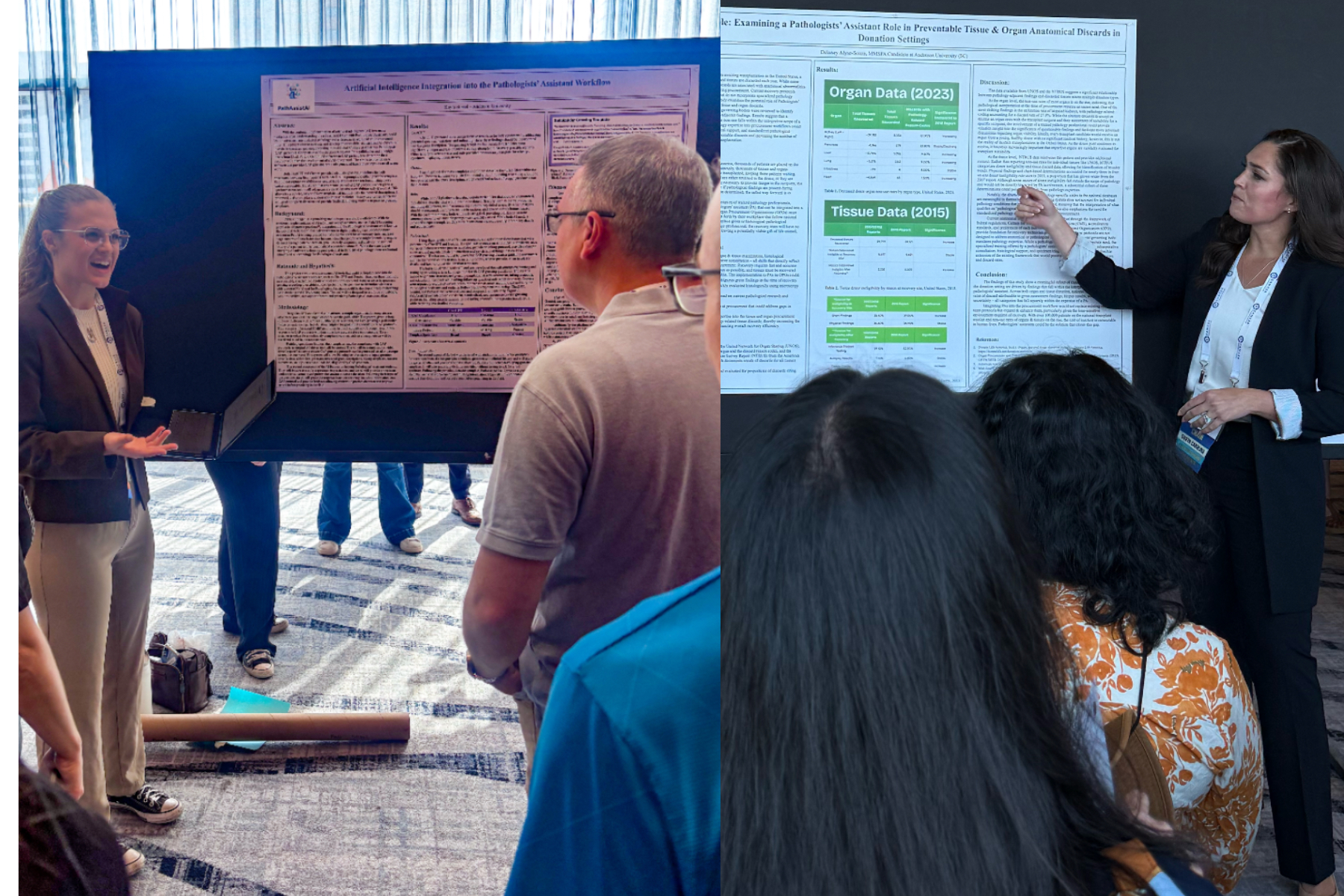
Thomas and Alyse-Souza’s selection as AAPA Student Delegates also reflects the growing national presence of Anderson University’s Pathologists’ Assistant program. Their ability to develop meaningful research, communicate their work to practicing professionals and represent AU on a national stage demonstrates the program’s commitment to preparing students not only for clinical practice, but also for scholarship, professional engagement and leadership within the profession. As the program continues to grow, opportunities like this highlight the caliber of its students and the strong foundation they are building at Anderson University.