

The Fulbright Program is an integral part of Anderson University’s emphasis on Great Academics. In fact, it’s a top strategic initiative for Anderson University.
Fulbright is the flagship international academic exchange program sponsored by the U.S. government in partnership with nations around the world.
Overall, the Fulbright Program awards approximately 9,000 merit-based scholarships in the United States and more than 160 countries every year to accomplished students, scholars, teachers, artists and professionals of all backgrounds and fields. Fulbrighters study, teach, conduct research, exchange ideas and contribute to finding solutions to complex global challenges.
For the past several years, Anderson University has focused on increasing the number of students who apply for a Fulbright Scholarship.
Among the applicants is Paris Freeman, a senior biochemistry major. Having been involved with the Anderson University Center for Cancer Research, Freeman set a goal to pursue more research opportunities and also to become an oncologist. She is looking into a master’s in cancer biology program offered through the Imperial College of London.
“I think the main ways it would benefit me personally would be to not only have grown my knowledge base through the research project and through those courses that are available, but also forming more worldwide connections,” Freeman said, adding that the research component would benefit her as she makes plans to further her doctoral studies.
William McArtor-Cline, a double major in biology and biochemistry, also has his sights set on studying in the UK. Previous travels to Panama with the AU Abroad program and a medical mission trip to the Dominican Republic while in high school inspired him to pursue more study abroad opportunities.
McArtor-Cline applied for the open award to potentially go to the University of Bath. He eventually wants to enter a Ph.D. program in the UK.
“The Fulbright really stood out to me,” he said. “Looking at the Fulbright, not only is it an opportunity to address some of the financial concerns, but it also gives you the opportunity to search out a community and make a place for yourself that is more like home, even though you’re in a place that you’ve never been.”
Mary Green, a senior majoring in elementary and early childhood education, is applying for an English teaching assistant position in Moldova, where she hopes to help students grow in their English vocabulary and using conversational English. She would also give presentations to familiarize Moldovan students with various aspects of American culture.
Green, who previously had traveled to Poland and Romania, was drawn to apply for the Fulbright because of their strong emphasis on cultural connections and on finding ways to bridge gaps between American culture and other cultures offering positive ways to learn and grow together.
“I feel it aligns with my values as an educator…. having experience internationally, working directly with students will be great for professional growth,” Green said. “I feel it fits my values of servant leadership.”
Luanne Plemmons, a senior majoring in computer engineering, originally considered a healthcare career, but found she could study engineering and make meaningful contributions to healthy living.
“I’m hoping to do a master of science in artificial intelligence specifically focused on the heart disease research that I was doing,” said Plemmons, who hopes to study in Scotland if she is awarded the scholarship. “I’m interested in the machine learning aspect of taking data analytics, taking that heart disease data, and then implementing it in a way that predicts whether or not patients are likely to see potential heart disease risk factors in the future.”
Plemmons sees in the Fulbright program a great way to marry graduate studies with traveling.
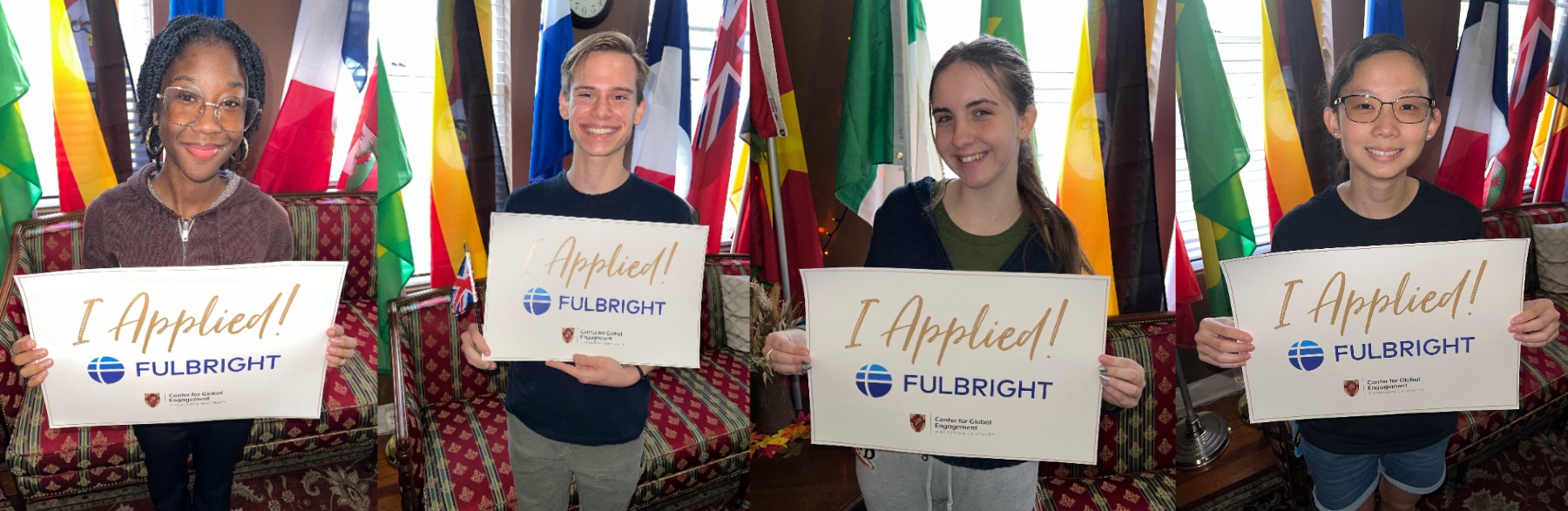
Some of the 2025 Fulbright applicants. From left, Paris Freeman, William McArtor-Cline, Mary Green and Luanne Plemmons.
Making Fulbright Connections
Dr. Ann-Margaret J. Themistocleous, Director of the Center for Global Engagement, has recently been selected as a Fulbright Specialist from 2025 to 2028. In this capacity, she will provide consultation to universities abroad regarding the development of partnerships with U.S. colleges.
Faculty Scholars
Additionally, Anderson University has had several faculty members receive Fulbright U.S. Scholar awards involving teaching and research abroad, helping to build international connections and share expertise with other countries. These include Professor of Finance and Economics Dr. Kent Saunders (Belarus), Organizational Leadership Professor Dr. Anthony Caito (Brazil), and English Professor Dr. Kolawole Olaiya (Nigeria). Associate Professor of History Dr. Lynneth Miller Renberg is currently conducting research in Norway.
About the Fulbright Program
The Fulbright Program is designed to increase mutual understanding between the people of the United States and the people of other countries. The Fulbright Program provides participants, who represent the breadth of U.S. society and of societies abroad and are chosen for their academic merit and leadership potential, with the opportunity to study, teach, conduct research, pursue professional projects, exchange ideas and contribute to finding solutions to shared international challenges. Grants are available for U.S. citizens to travel abroad and for non-U.S. citizens to come to the U.S. The Fulbright Program is an important element of the United States’ bilateral relationships with countries around the world. U.S. and foreign governments jointly set priorities for the exchanges.
The Anderson University Center for Global Engagement has Fulbright Program Advisors available to assist students with their application. Find out more about Fulbright and other available scholarships here. Details about the Fulbright Program can be found at www.fulbrightprogram.org.